What M4M Massage Means and What to Expect From a Session
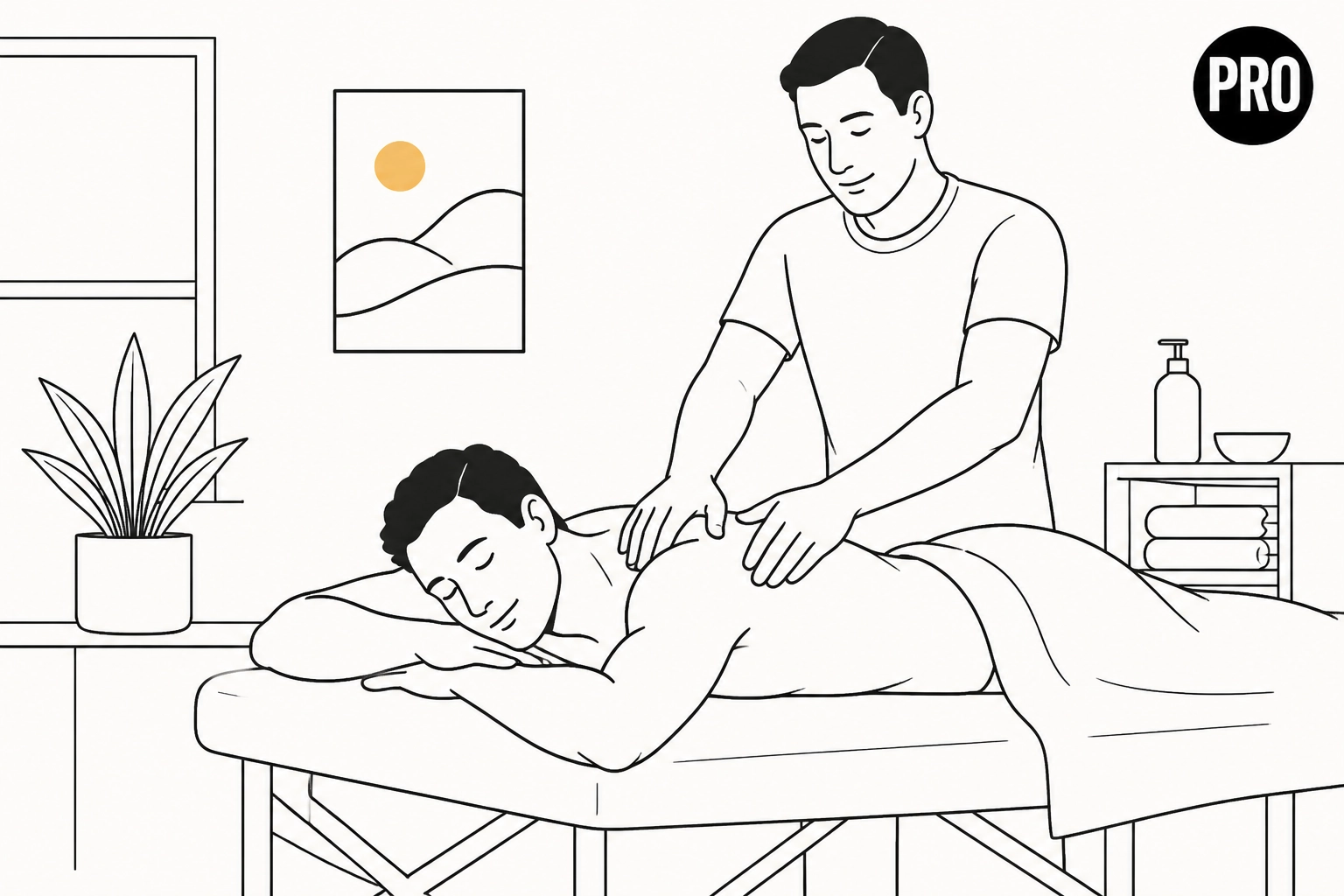
Search “M4M massage” and you find the same thing everywhere: listings, rates, and unspoken assumptions. Most of them never explain what the term actually…
Search “M4M massage” and you find the same thing everywhere: listings, rates, and unspoken assumptions. Most of them never explain what the term actually covers, so a first-timer is left guessing what they are booking — and what they are allowed to ask for when they get there.
M4M describes who is in the room: a male therapist working on a male client. It is not a service menu. Treat the booking as a licensed health-care service and you can handle it like one — verify the license and the all-in price before you pay a deposit, know what you can ask for, and know you can decline or stop. Then book with one short, unambiguous message. You can compare therapists on the ProMasseurs directory first.
M4M Means Male Therapist, Male Client — Not a Service Menu
M4M is shorthand for "male for male": a male therapist working on a male client. That is the whole of it. It describes the pairing in the room — not a technique, not a price tier, and not a promise about what happens once the door closes. Search results rarely say this plainly, so the label gets read as a menu when it is only a description of who.
What the Label Doesn't Tell You
An M4M booking can be Swedish, deep tissue, sports, or trigger point work. Modality is a separate choice you make from the therapist's listed services, and it is the thing that actually determines how the session feels — pressure, pacing, whether you leave loose or sore. Choose the modality first, then the therapist who offers it.
Can a Male Be a Massage Therapist?
Yes. Licensure rests on training hours, supervised practice, and a state exam, none of which are gendered. Men are a minority of licensed therapists, which is why a male-only directory like ProMasseurs exists at all.
"Male Full Body Massage"
The same idea with a scope attached: back, legs, arms, chest, neck, and scalp, worked under standard draping. Full body means coverage, not suggestion.
The Frame for Everything Below
California's massage statute states the Legislature's intent is that regulation reflect the recognized status of certified massage professionals as health care providers (Section 4600.5(e)). Start there and most of the confusion around the term dissolves.
Your First Fifteen Minutes: Intake, Draping, and Saying "Lighter"
Expect an intake before you undress — a short form or a two-minute conversation covering health history, injuries, surgeries, medications, areas to avoid, and pressure preference. You can decline anything that isn't health-relevant, including questions about your job, your relationship, or why you're booking. A professional takes the "no" and moves on.
Draping works in one direction
Draping is standard: you're covered by a sheet or blanket, and only the area being worked is exposed. You may ask for extra draping or to leave your underwear on. A professional agrees without commentary or negotiation.
Set the pressure scale early
Agree on a scale in the first two minutes. "Tell me where you are on a 1-to-10, I want to work around 7" is a normal opening, and so is "lighter" said three times. A good therapist names the technique before applying it, checks in as he moves to each new area, and adjusts without making it a thing.
Stopping is always allowed
Say "stop," sit up, get dressed, and leave. Ask when you book what happens if you end a session early — many therapists charge the full rate regardless of how long you stayed.
Normal versus notable
Silence is normal. Conversation is normal. Being asked to reposition or breathe is normal.
Notable: a therapist who won't explain a technique before doing it, or who dismisses a pressure request. That's your cue to pause rather than push through.
Consent, Boundaries, and Where Therapeutic Massage Ends
Consent in a massage session is ongoing and specific. A yes at booking covers exactly one thing: the massage you described. It does not carry over to anything else, and you can withdraw it mid-session — "stop" and "that's enough" end whatever is happening. The therapist can end the session too.
What a License Covers
A massage license covers therapeutic massage only. Sexual services sit outside the scope of practice, are illegal to sell in most states, and would put a therapist's license and business on the line. If a provider offers more, decline, end the session, and report it. If you ask, expect to be refused and asked to leave.
Read the Advertising as the Tell It Is
"Sensual," "full service," explicit photos, or a rate quoted for something unnamed signal a different business than the one described in this article. Regulators read those ads the same way: one California city's proposed rules dated May 27, 2026 would bar "sexually suggestive content" in massage advertising and ads on "websites known to promote illicit activity" — the page doesn't show whether they were adopted.
Enforcement numbers are rough. A Houston estimate cited in legal-industry coverage puts "over 200 active parlors" in the city, more than a third of the state total — but it comes from a review site where sex buyers post, so read it as a signal of volume, not a count.
The Practical Filter
If the exchange turns into a negotiation about anything other than time, price, pressure, and location, walk away before you send a deposit. That's the standard on ProMasseurs: a profile, a rate, a direct message — nothing to negotiate.
Checking a License in Texas or New York — and What It Doesn't Prove
Get the license number before you book and look it up yourself. In Texas, search the Department of Licensing and Regulation (TDLR) license database. In New York, the Office of the Professions lookup covers the therapist, and a New York City spa also needs a Department of Consumer and Worker Protection establishment license. A listing that says M4M massage gets the same lookup as any other.
What the Lookup Doesn't Prove
State law bars cities and counties from prohibiting licensed professionals from performing acts inside their recognized scope of practice, but it still lets them regulate zoning, business licensing, and health and safety. So "the city shut the place down" and "he isn't licensed" are different problems, and local registration can be suspended or revoked for violations.
Ask Before You Pay a Deposit
Liability insurance?
Table and fresh linens, or a home setup?
Studio, or travel to you?
Citrus Heights is revising its licensing, insurance, and enforcement rules, including a $1,000,000 liability minimum — the direction is toward asking, not assuming.
Growth is outrunning the rules there: establishments have nearly doubled since 2019 while its rules date to 2018. In a crowded market, verifying one therapist beats trusting a category, so check each ProMasseurs profile individually.
Ask for two recent reviews or references that mention the modality you're booking. A therapist who can't describe his training for trigger point or sports work in specific terms has told you what you need to know.
What $100 Buys: Tipping, 60 vs. 90 Minutes, and Add-Ons
A quoted rate is rarely the final number. Separate time, tip, travel, and add-ons, and you can compare providers on equal footing.
Tipping
On a $100 massage, a customary tip for therapeutic work is handed over in cash at the end. Ask upfront whether gratuity is already built into the quoted rate — many independent therapists price it in, and paying twice is the most common first-timer mistake.
What the Clock Buys
60 minutes covers back, legs, and shoulders, with little room for focused work.
90 minutes buys a full-body pass plus 20–30 minutes on one problem area.
120 minutes is for combining modalities or working two areas.
Where Add-Ons Belong
Trigger point work is sustained pressure — typically 20 to 90 seconds per point — on a taut band of muscle that refers pain elsewhere. It's usually sold as a 15- or 30-minute add-on rather than a full session. Hot stone, cupping, and stretching are priced the same way.
What Moves the Price
Incall studio versus outcall to your home or hotel (travel fee and setup time), evening and weekend rates, and whether the therapist is licensed and insured. The cheapest listing is usually the one with the fewest answers.
Compare on the total: rate plus tip plus travel plus add-ons plus deposit. Ask for the all-in number in your first message, and price three providers in your city before you choose — compare rates and services on ProMasseurs profiles first.
A Five-Minute Booking Script, From First Message to Follow-Up
The Five Lines
Send five lines and nothing else: your name, your city or neighborhood, the date and time you want, 60 or 90 minutes, and incall or outcall with a pressure preference. Then ask for the all-in rate including gratuity and whether a deposit is required. Anything longer invites negotiation you didn't ask for.
Three Questions Before Any Money Moves
Ask for the license number, the exact address or travel radius, and the cancellation policy. Anyone who dodges one of the three has answered a different question for you — treat that as your answer.
Browse Before You Commit
Treat a listing as a starting point, not a contract. Rates and services on a profile should match what the therapist confirms in writing. Start at ProMasseurs and pick your city, or go straight to the gay massage in New York if you're booking there.
On the Day
Arrive clean, bring cash for the tip, and in the first minute say what you want worked on and what to skip. Confirm your draping preference before you get on the table, not halfway through.
Leave if the space isn't a proper treatment room, the rate changed at the door, or the conversation turns sexual. If you paid a deposit, ask for it back in writing the same day and report the listing.
Afterward, note the pressure, focus areas, and room setup that worked. Rebooking the one therapist you trust beats rotating through strangers, and the second session is where the bodywork actually starts.