
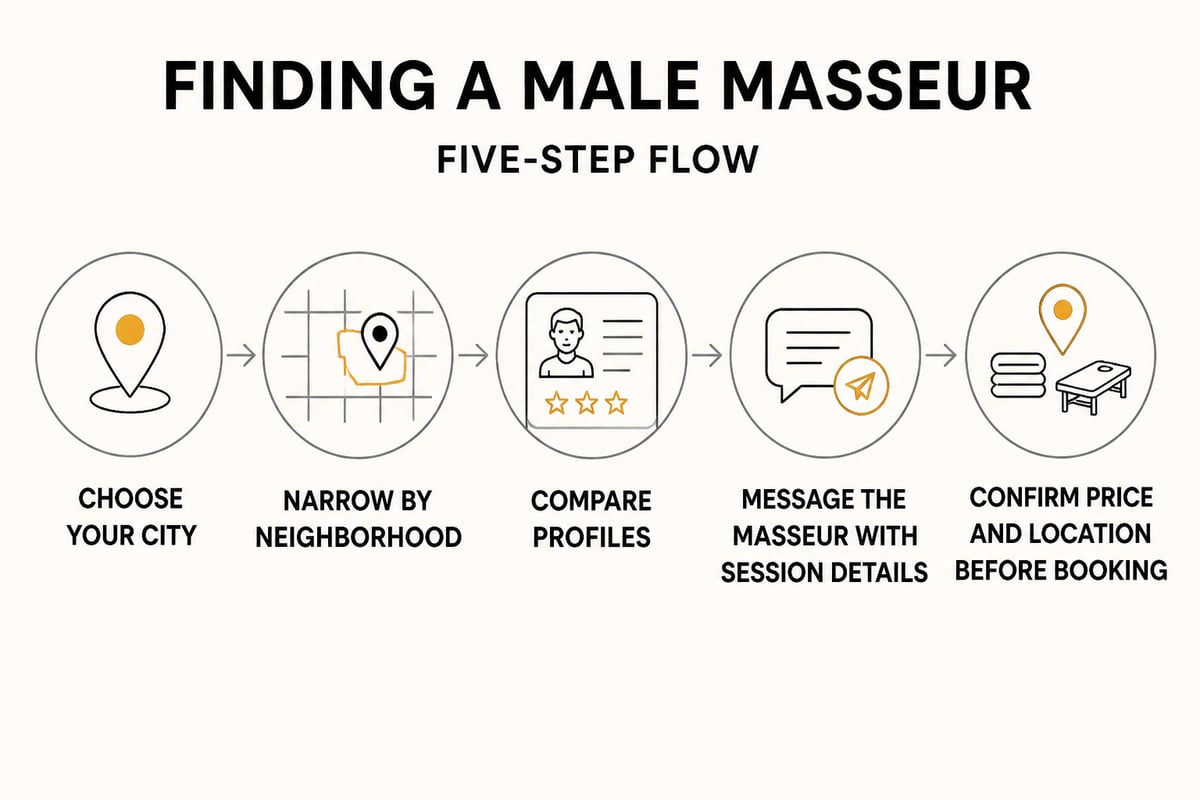
If you're looking for massage by a man, the quickest route is a directory that lists independent male masseurs by city, so you can compare profiles, styles and rates before you reach out. Start with your city, narrow to your neighborhood, read what each masseur says he offers, and message him with the details of the session you want. This guide walks through each step, from where to search to what to ask before you confirm.
What does "massage by man" actually mean?
Massage by a man simply means the person working on you is a male masseur, and for many gay, bisexual and queer men that is a comfort choice before it is anything else. You may feel more at ease, more able to talk plainly about what you need, and less likely to spend the first ten minutes managing awkwardness.
You'll see a few related labels, and they're worth separating:
- Male massage usually describes a masseur working on male clients.
- Gay massage signals that the provider is comfortable and welcoming with gay and queer clients.
- M4M massage means male-for-male. It describes the pairing of provider and client, not one standard technique or package.
That last point matters. M4M is a label, not a menu. A masseur who uses it could offer deep tissue, Swedish, Thai, sports massage or something gentler and slower, and the label alone won't tell you which. Read his own description rather than guessing from a tag. If you want a deeper look at the term, the man2man massage article breaks down how people use it.
Why do some men prefer a male masseur?
Men choose a male masseur for different reasons, often comfort and communication, and there is no single right reason. You don't need to justify the preference to anyone.
Here are the reasons that come up most often:
- Ease around your body. Some men relax faster when they aren't worried about how they'll be perceived.
- Straightforward conversation. Describing a tight hip, a sore lower back or a hard week at the gym can feel simpler with someone who gets it.
- Gay-friendly by default. In a space built for gay and queer men, you don't have to explain who you are or edit what you say.
- Pressure that matches your build. Some clients like a masseur who can work firmly through larger muscle groups, though plenty of masseurs of every description can do this.
None of this is a promise about any individual masseur. Skill, communication and professionalism vary from person to person, which is why comparing profiles matters more than the label. For more on the general upsides, the piece on benefits of massage therapy for men is a useful read.
Where can you find a male masseur near you?
The most efficient place to start is a directory built around male masseurs, where you can browse by city and neighborhood instead of scrolling through general massage listings. ProMasseurs is one such directory: it lists independent male masseurs for gay, bisexual and queer men, searchable by city and by specialty.
A few ways to search that work well:
- Start with your city page. Pick your city, then look for neighborhood links so you can see who is actually close to you or willing to travel to you.
- Filter by what you want. Searching for a style such as sports, Thai or relaxation massage gets you closer to a good match than browsing everyone.
- Use word of mouth as a cross-check. Friends, local gay community groups and neighborhood forums can tell you what to expect in your area.
If you're in New York, the New York directory links to boroughs and supported neighborhoods, so you can compare each masseur's real location or travel area instead of guessing. In Florida, pages like gay massage in Wilton Manors work the same way for that neighborhood.
ProMasseurs is a directory, not a spa, and it isn't the employer of the masseurs listed. Each one is independent, sets his own rates and services, and confirms sessions with you directly. Think of the listing as your introduction, not a guarantee.
How do you compare male masseur profiles?
Compare profiles by looking at the same few details on each one: what he says he offers, where he works, how long a session runs and what he charges for that length. Doing it the same way every time keeps you from being swayed by one good photo.
Check these on every profile:
- Photos and description. Do they feel current and professional? Does the description sound like a real person who explains what he does?
- Style of massage. Swedish, deep tissue, sports, Thai and relaxation massage are quite different experiences. If you're unsure which suits you, the guides to deep tissue massage and relaxation and wellness massage explain the differences in plain terms.
- Location or travel area. The neighborhood he works in, or the areas he'll travel to.
- Published rates. Where a masseur supplies a rate, treat it as a starting point for that session length and service.
- Contact options. A clear way to reach him is a good sign that he expects questions.
Don't read more into a profile than it says. A label like gay-friendly or M4M doesn't tell you a provider's boundaries, qualifications or exact services. If something isn't stated, ask.
What is the difference between incall and outcall?
Incall means you travel to the masseur's stated location, and outcall means he travels to a place you've agreed on, such as your home or hotel. Which one fits depends on your comfort, your schedule and whether you're at home or traveling.
| Incall | Outcall | |
|---|---|---|
| Where it happens | The masseur's location | Your home or hotel |
| You provide | Your time and travel | A comfortable, private space |
| Often worth asking | Parking, access, building entry | Travel fees, table or equipment, hotel rules |
| Good for | Locals who want a set-up designed for massage | Visitors and anyone who'd rather stay put |
Availability, travel areas, equipment and fees vary by provider, so confirm every one of these before you plan around them. If you're traveling, check whether your hotel has rules about visitors, and make sure you have enough space for equipment if he's bringing a table.
How do you compare prices without surprises?
Compare the same session length and the same service across masseurs, then ask for the total quote. An advertised starting rate may not describe the session you actually want, and ProMasseurs doesn't set one universal rate. Each masseur sets his own.
When you ask for a total, find out whether any of these apply:
- Travel charges for outcall
- Equipment or table fees
- Venue or room fees
- A deposit to hold the time
- Whether gratuity is included
Write the numbers down side by side if you're weighing two or three people. A lower starting rate can end up costing more once travel and extras are added, and a higher one can turn out to be all-inclusive. Treat any figure on a profile as belonging to that masseur, that session and that day, not as a city average.
What should you include in your first message?
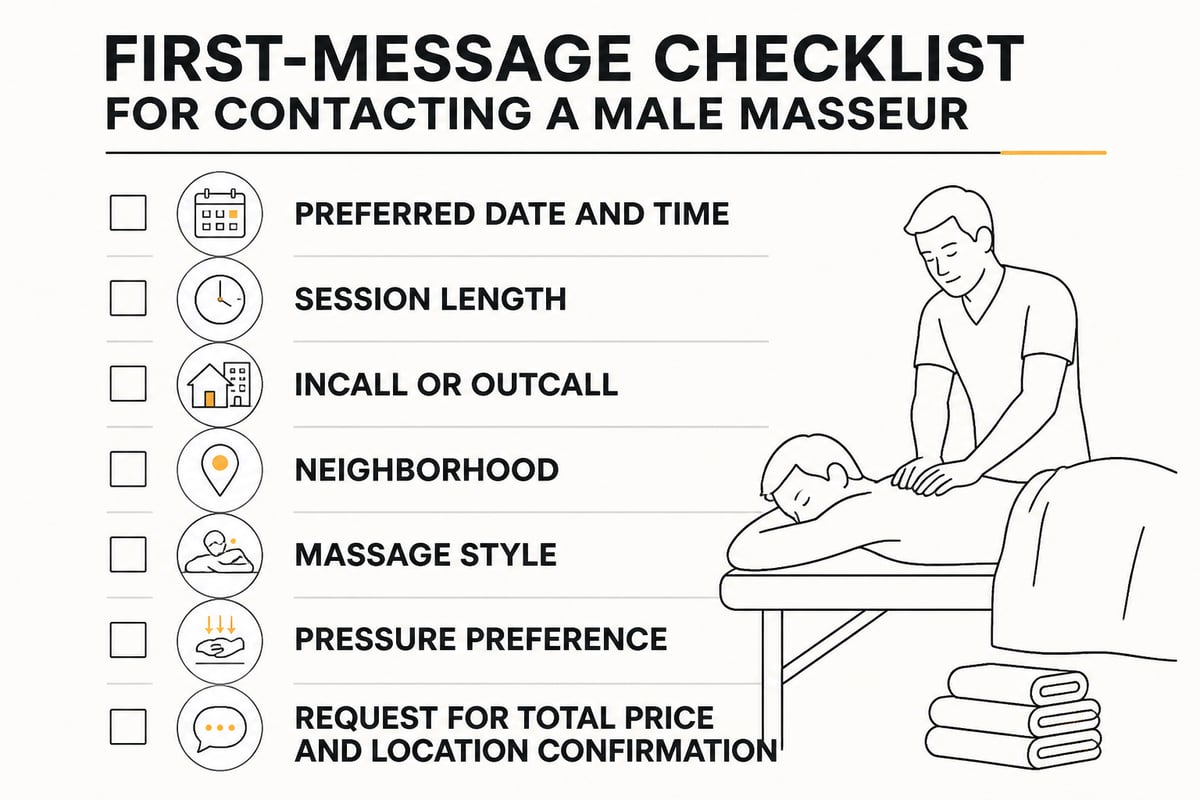
A good first message gives the masseur everything he needs to answer in one reply: when, how long, where and what kind of massage you want. It saves you both back-and-forth and signals that you're a considerate client.
Include:
- Preferred date and time, plus a backup window if you're flexible.
- Session length, such as an hour or ninety minutes.
- Incall or outcall, and your neighborhood if it's outcall.
- Massage style and pressure, for example "deep tissue, firm" or "slow and relaxing, light pressure."
- Any areas to focus on or avoid, like a stiff shoulder or a sensitive knee.
- A request to confirm availability, the final price and the exact location before you make plans.
Keep it polite and specific. A short, clear note usually gets a faster and more useful reply than a vague "are you free tonight?"

Which massage style should you ask for?
Ask for the style that matches what your body needs that day, and say so in your own words if you don't know the technical name. Most masseurs will adjust once you explain what you're after.
- Swedish or relaxation: long, flowing strokes at lighter pressure. Good for stress and an overworked week. Our guide to deep tissue vs. Swedish massage helps you choose between the two.
- Deep tissue: slower, firmer work on stubborn tension in the back, neck and shoulders.
- Sports massage: focused on the muscles you train, before or after heavy activity.
- Thai massage: stretching and compression, usually on a mat and with clothing on, so it feels more like assisted movement.
If you're new to all of this, relaxation or Swedish massage is a gentle place to start. You can always ask for more pressure partway through, and a good masseur will check in. There is no prize for taking more pressure than feels right.
Do you need to check training and licensing?
Yes, it's reasonable to ask a masseur about his training and experience, and you should feel free to do it. Rules differ a lot by place. Licensing rules differ a lot by place. Texas, for example, requires at least 500 hours of massage therapy education and an acceptable exam for licensure, while Florida requires completing a board-approved course of study and passing a designated national exam.
ProMasseurs does not claim that every listed provider is licensed, vetted or medically qualified, so don't assume it from a listing. If credentials matter to you, ask the masseur directly what training he has and what he is licensed for in your area, then check with your local licensing authority if you want to confirm it.
If you're dealing with chronic pain, ask a trusted source for a referral and check the practitioner's training, experience and familiarity with your condition. Massage here is for relaxation and general wellness, not diagnosis or treatment. For a medical concern, see a health professional first.
Is massage safe for everyone?
Massage by a trained practitioner appears to carry few risks, but some health conditions may require precautions, so talk with your health care provider about safety.
Tell your masseur before the session starts if you:
- Have a recent injury, surgery or an area that's tender or inflamed
- Take blood thinners or have a clotting condition
- Are managing a chronic condition or an ongoing medical treatment
- Have skin conditions, allergies or sensitivities to oils or lotions
Speak up during the session too. Pressure that feels too firm, a position that's uncomfortable or anything you'd like to skip is always fair to mention. A good masseur wants that feedback.
How do you prepare, and what happens at the session?
Preparing is mostly practical: confirm the details, arrive on time, and shower beforehand if you can. At the session itself, the masseur will usually talk through what you want, step out while you get settled under a sheet or towel, and check in as he works.
A simple routine helps:
- Re-confirm the time, price and location a few hours ahead.
- Eat lightly and avoid heavy alcohol beforehand.
- Arrive a few minutes early for an incall so you aren't rushed.
- Share anything relevant about injuries, preferences or boundaries at the start.
- Drink water afterward and give yourself a little quiet time rather than rushing to the next thing.
Clear communication is the whole game. Ask for what you want, say stop if something isn't right, and remember that a professional session respects your limits. ProMasseurs is built for gay massage and male bodywork, not for non-massage or sexual services, so keep your requests to the massage you've agreed on.
Frequently asked questions
Can I find a male masseur if I'm traveling?
Yes. Look up the city you're visiting, browse neighborhoods near your hotel and compare profiles the same way you would at home. Ask about outcall if you'd rather he come to you, and confirm the location and price before you finalize plans.
Is massage by a man always M4M massage?
Not necessarily. M4M means male-for-male and describes the provider and client pairing. A masseur's actual style, services and boundaries come from his own profile and what he tells you directly, so read and ask rather than assuming from the label.
How long should my first session be?
Many first-timers choose an hour, which is enough time to settle in and feel the work. If you want to try deeper work or cover more areas, ask the masseur whether ninety minutes makes sense. Compare quotes at the same length so prices are fair.
Do I contact the masseur or the directory?
You contact the masseur. On ProMasseurs, you use the contact options on his profile, and the independent provider confirms availability, location and final price with you.
What if I'm not comfortable once the session starts?
Say so right away. You can ask for lighter pressure, a different area or a pause, and you can end the session. A professional will respect that without making it awkward.
Your next step is to pick your city, shortlist two or three profiles and send each one the same short message with your date, session length, incall or outcall preference and massage style. When you're ready to look, Gay Massage shows how city and neighborhood browsing works, with male therapists you contact directly. ProMasseurs lets you find gay massage and male masseurs by city and specialty, compare profiles side by side and reach out to independent providers on your own terms.