Deep Tissue vs Swedish for Male Bodywork: Before You Book
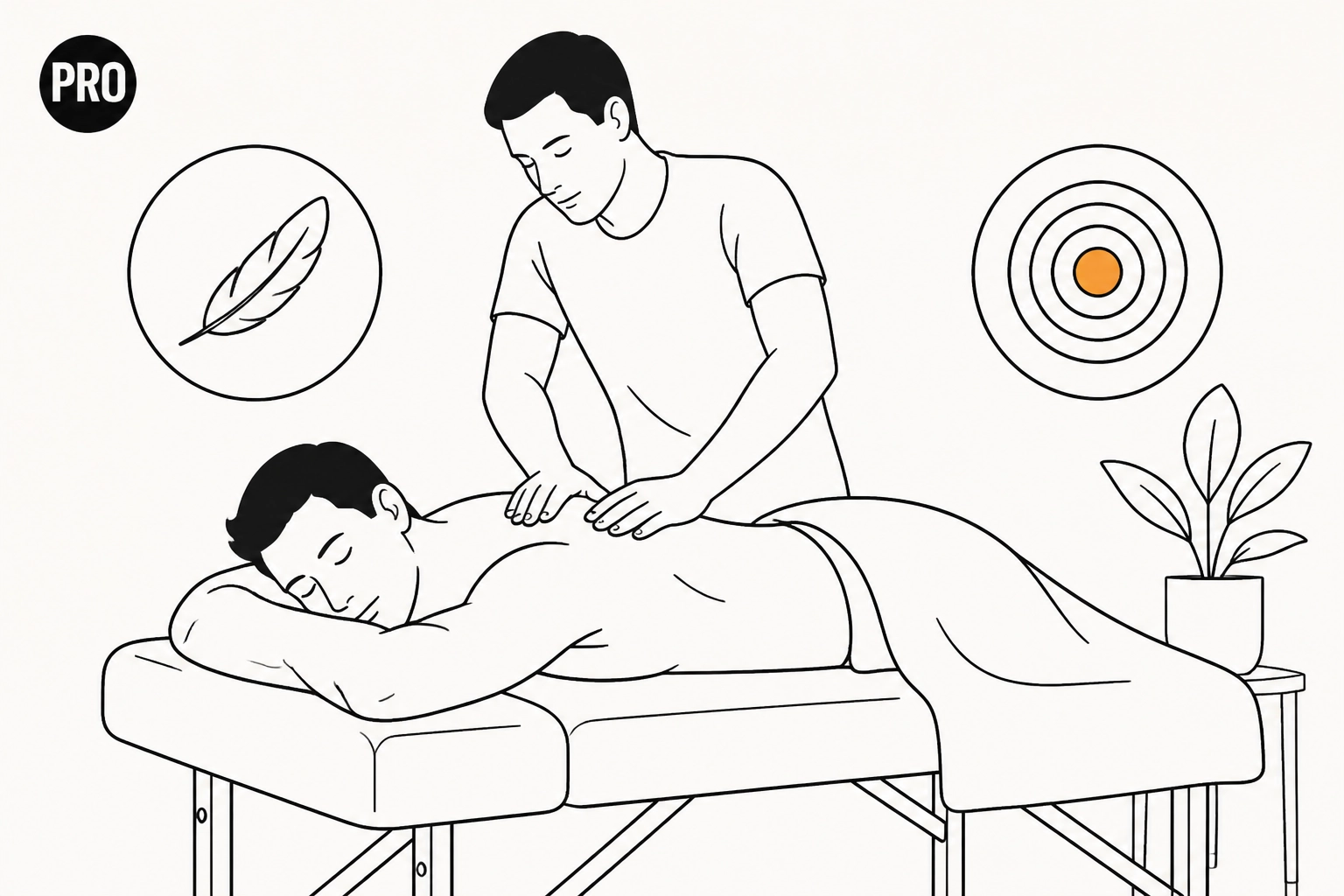
Swedish and deep tissue differ by pressure, pace, and focus, not quality. Compare both, match the work to your booked time, and learn what to say.
Booking a massage shouldn't feel like a pop quiz, but there you are, staring at a menu that lists Swedish and deep tissue and wondering which one you actually want. Here's the honest answer: they describe pressure and technique, not quality and not a promised outcome. The right pick is the modality whose pressure and pace match your goal within the session length you actually booked. That's what this swedish massage vs deep tissue guide covers.
We'll start with what Swedish and deep tissue have in common (more than you'd think), then look at Swedish as light to medium, flowing, whole body work, and deep tissue as firm, slow, and held on one spot. From there, a side by side comparison, how to match pressure and pace to the session length you booked, and the words to use in your first message, including scripts for asking for Swedish and for deep tissue. We'll also cover oil, draping, and feedback during the session, plus questions to ask before you book.
If you can't name the difference out loud, that's the question to put in your first message. Let's sort it out.
What Swedish and Deep Tissue Have in Common
Both Swedish massage therapy and deep tissue massage are commonly described the same way at the start: full body work, oil, a padded table, and a drape. That means the room and the booking conversation look almost identical before the first stroke.
The main differences come down to how hard the pressure is, how slow the pace is, and how long the work stays on one area instead of moving on. Neither name is a quality tier. Swedish is not the beginner version of deep tissue, and deep tissue is not a serious upgrade; one massage school guide frames the choice as a question of fit, not ranking.
One caveat: the pressure ranges used later here are industry convention, not official standards. Read them as vendor conventions rather than anything regulated.
Because the setup is shared, many providers can deliver either style in the same session length, in call or out call. Start with this overview of how gay massage booking works, which covers consent and provider checks.
Swedish Massage Therapy: Light to Medium, Flowing, Whole Body
If you are new to male massage, Swedish is often the first style people try.
Pressure: Swedish is generally placed at light to medium pressure. The useful caveat: firm Swedish is still Swedish, as long as the strokes keep flowing instead of stopping to hold.
Pace: long, continuous, rhythmic strokes that travel from area to area. That flow is why one session can cover a great deal of the body in a single pass.
Oil: typically generous in practice, since gliding hands need glide, and the oil is part of how the pace stays continuous.
Next day: soreness after Swedish is generally described as uncommon and mild. That matters if you have travel, training, or physical work the next morning.
Why people book it: to unwind, ease general tension, try a first session, or feel what bodywork is like before asking for firmer work.
Deep tissue turns each of those three dials the other way.
Deep Tissue Massage Therapy: Firm, Slow, Held on One Spot
Where Swedish keeps moving, deep tissue slows down. It is generally placed at medium to firm, sometimes intense, at or above the top of the Swedish range.
Pace is the giveaway: strokes stop, hold, and stay on one spot instead of flowing to the next area. The word deep is generally taken to mean slow, angled strokes that work into deeper layers, not maximum force. Pushing harder is not the same as going deeper.
Oil is often used more sparingly, so the hands grip tissue rather than slide across it. That single change is what makes the work feel different from a Swedish pass.
Plan around the next day: soreness after deep tissue is commonly described as lasting about a day, which matters if you have a physical morning or a long drive home. If the vocabulary of male bodywork is new to you, what M4M massage means is the place to start.
Swedish vs Deep Tissue, Side by Side
With both halves on the page, the two styles line up in four rows.
Swedish massage therapy | Deep tissue massage therapy | |
|---|---|---|
Pressure | Lighter | Firmer |
Pace | Continuous, flowing strokes | Slow strokes that stop and hold |
Coverage | Moves across the whole body | Fewer areas, named in advance |
Oil | More glide | More grip |
The oil is the first thing you feel. A slippery, gliding hand generally reads as Swedish; a grippier, drier hand generally reads as deep tissue work.
Here is the honest part. Neither style is a cure, and claims of better circulation, sleep, or lasting relief rarely come with evidence. Massage research leans heavily on self-report measures, so proof stays thin. Choose on pressure and pace, not on which promise sounds better.
Next, fitting that pressure and pace into the session length you actually booked.
Matching Pressure and Pace to the Session Length You Booked
Once you have settled on a pressure and pace, the length you book decides how much of the body that style can actually cover. Slow work on one spot takes longer than a flowing pass across the body, and no source in this research pairs session length with modality, so treat the following as practical guidance.
60 minutes: usually fine for Swedish pace across the whole body, or deep tissue on one or two areas you name. Asking for firm, slow work everywhere in an hour tends to mean thin coverage or a rushed feel.
90 minutes: the common middle ground, enough room for flowing full body work or firm, slow work on a few areas without watching the clock.
120 minutes: space for slow work on multiple areas, or firmer work first and flowing work to finish.
Ask before booking whether your goal fits the length you want. If it does not, book longer or narrow your focus to fewer spots. To go further, how to vet a male masseur covers the questions worth asking first.
The Words to Use in Your First Message
Once you know what your session length can hold, put four things in your first message: the modality, the pressure, the focus, and how long you are booking. That is it. A provider decides what they can deliver from what you actually write, so short and specific beats a paragraph about your week.
Include whether you want in call or out call, and the session length, so pressure expectations get matched to time before you commit. Something like: "Firm and slow, focused on my upper back, 90 minutes, out call."
If the listing's stated style does not match your words, that is the moment to ask which modality the provider actually works in most. Our guide to picking a provider covers the rest.
A Script for Asking for Swedish
Here is the Swedish version of that message, once you have swapped in your own details:
Hi, I would like a Swedish session, 60 minutes, out call. I want to relax rather than target one spot: light, flowing, whole body work. Light to medium pressure, please, and keep it moving through the whole session.
Firmer is fine too. Say: "Firm Swedish is fine, as long as the strokes stay continuous." Adding "no need to stop and hold anywhere" tells the provider you want Swedish pace, not deep tissue focus. Swap in your own length or setting freely; the pressure and continuous-stroke wording is what keeps the work Swedish.
Next, the same treatment for deep tissue.
A Script for Asking for Deep Tissue
For deep tissue, swap the flowing request for a focused one. Try this:
"Firm and slow work, focused on my upper back and right hip, 90 minutes. Medium to firm pressure on those two spots. Please take your time there instead of covering everything. And tell me if that does not fit the session length I asked for, or if you would work differently."
That last line matters. It invites the provider to say whether two named spots fit 90 minutes, or to suggest fewer areas or a longer booking. Once you send it, the next things to settle are oil and draping.
Oil, Draping, and Feedback During the Session
Once you are face down, oil and drape do more of the talking than your script did.
Oil is the practical difference spa guides describe: generous for Swedish so hands glide, lighter for deep tissue so hands can grip. If the glide feels wrong for the pressure you wanted, say so early. Waiting means the whole session drifts from your goal.
Draping habits vary by provider and by setting. Ask what the standard is for the session you booked, especially for out call work in your own space. You can request more or less coverage, or a warmer drape, at any point. That is a normal request, not an awkward one.
Pressure is a running conversation, not one answer given once. "More," "less," "stay here," and "that's good" are enough vocabulary in the moment.
Name any area you want skipped and any you specifically want worked at the start, rather than hoping it comes up later.
Most of these work better as a question before you book than an in-session correction.
Questions to Ask Before You Book
You know what to say in the room. Before you book, get these answers in writing.
Which modality do you actually work in most, and how would you describe the pressure and pace in your own words? If the answer is "therapeutic massage," ask what that means to them; it isn't a standard pressure level.
Does my goal fit the length I'm booking, or should I book longer or narrow the focus to fewer areas?
How much oil do you typically use, and how do you handle draping for an in call versus an out call session?
Do you stay in one style the whole session, or can you move from firmer, slower work into flowing strokes as you go?
What does the following day usually feel like for clients in each style? Soreness expectations decide whether you plan a workout or a long drive afterward.
If a provider can't answer these plainly, that's useful information too.
Choosing Your Modality, Then Finding a Male Masseur
Once you have your answers, the choice itself is simple. Start from your goal, not the name. Want light to medium pressure that keeps flowing across your whole body? That points to Swedish massage therapy. Want firm, slow work held on two or three spots you can name out loud? That points to deep tissue massage therapy.
Then line up three things before you commit: the session length you booked, whether you want in call or out call, and the pressure words you are ready to say. A firm-everywhere request in 60 minutes rarely fits.
Next, compare male masseur listings on the matching ProMasseurs city and directory pages, and read each provider's stated style and session options. Not sure how to screen one? Our guide to shortlisting and verifying providers covers it.
Send the script from this guide in your first message, then confirm modality, length, and setting before you commit. If a listing stays vague about pressure or pace, ask that first. Deep tissue is not automatically the firmest option on offer.
Conclusion: Name It, Say It, Then Book
Swedish tends lighter and keeps flowing across the whole body, with more oil. Deep tissue tends firmer, slower, and held on the areas you name. That is the whole comparison.
So choose on pressure and pace, not on which name sounds stronger, more advanced, or more serious. Then check the fit against the session length you booked. If slow work on several areas will not fit, book longer or narrow your focus to fewer spots.
Your first message should state four things: modality, pressure, focus, and duration. Something like, "Firm, slow deep tissue on my upper back and right hip, 90 minutes, out call." Then take that exact request to a live ProMasseurs city or directory listing and book.
If you only remember one thing, let it be this: the modality you cannot explain out loud is the question to put in your first message. Ask it, and you are ready.