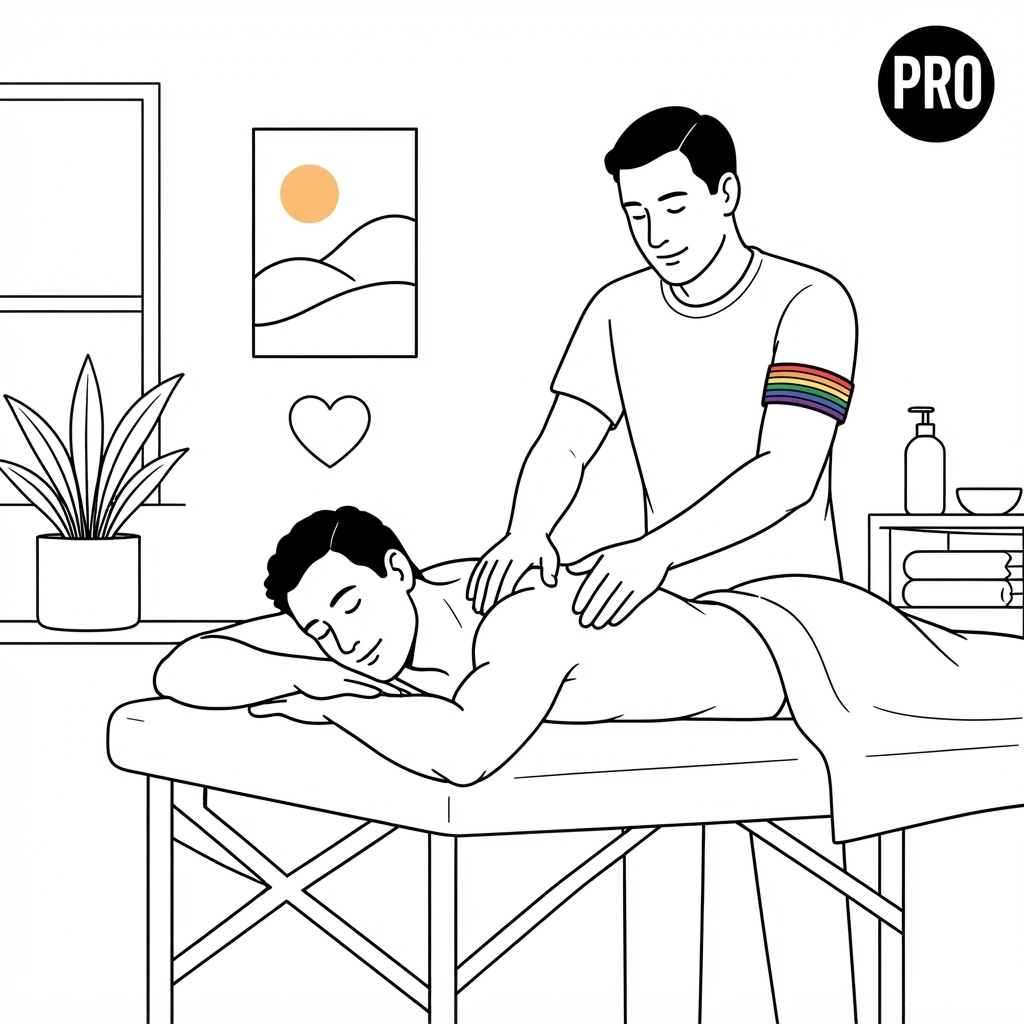
A search for gay massage or an LGBTQ+-friendly massage provider can lead to very different kinds of profiles. The useful question is not whether a page uses the right label. It is whether the provider communicates respectfully, explains the offered service clearly, and gives you enough information to make an informed booking decision.
This guide explains what LGBTQ+-affirming practice can look like before, during, and after an appointment. It also shows which details still require direct confirmation.
1. What LGBTQ+-affirming massage means
An affirming provider treats your identity and relationships with ordinary respect. That can appear in language, intake questions, privacy practices, and the way boundaries are discussed.
| Useful signal | What it may look like |
|---|---|
| Inclusive language | The profile welcomes LGBTQ+ clients without stereotypes or assumptions |
| Relevant questions | Intake focuses on the appointment rather than unnecessary personal details |
| Clear service scope | The provider explains session style, duration, clothing or draping expectations, and boundaries |
| Respectful communication | Your name, pronouns, partner, and questions are handled without judgment |
| Practical transparency | Location, price, payment, cancellation, and availability are easy to confirm |
No single symbol, phrase, or identity guarantees a good fit. Look for consistency between the profile and the provider’s direct reply.
2. Decide what you need before searching
Write down the practical requirements for your appointment:
- city or neighborhood;
- incall, outcall, or either;
- preferred date and time;
- session duration;
- the service or style you are requesting;
- accessibility or communication needs;
- budget and payment preference;
- any qualification that matters for your intended session.
If your priority is proximity, begin with the gay massage near me guide. If you are comparing credentials and individual providers, use the gay massage therapist near me guide.
3. Read profiles for evidence, not labels
A detailed profile should help you answer concrete questions. Look for a current service area, session options, availability, contact method, price information or quote process, and written policies.
Terms such as “gay-friendly,” “inclusive,” “professional,” or “experienced” are descriptions, not independent proof. A provider can support those descriptions with specific information:
- how appointments are arranged;
- what the session includes and excludes;
- relevant training or credentials;
- languages spoken;
- the setting and access instructions;
- cancellation and deposit terms;
- how client information is handled.
Use Browse to compare several profiles. Do not assume an omitted field means yes or no; add it to your questions.
4. Check qualifications in the correct jurisdiction
Credential rules vary by location and by the service being offered. Some jurisdictions license or register massage professionals; others use different systems or do not regulate every form of bodywork in the same way.
When qualifications matter:
- Ask for the exact credential name and issuing organization.
- Check an official public registry when one exists.
- Match the name and current status to the person you are considering.
- Ask about training relevant to the advertised service.
- Choose an appropriately regulated healthcare professional when you need medical diagnosis, rehabilitation, or treatment.
The massage therapist selection guide provides a broader comparison framework. A directory profile should not be treated as verification of every provider statement.
5. Confirm the appointment in writing
Before paying or traveling, request one message that confirms the complete booking.
| Detail | What to confirm |
|---|---|
| Provider | Name and current profile or contact identity |
| Time | Date, start time, and session duration |
| Location | Incall address timing or outcall service area |
| Service | The session being booked and its boundaries |
| Price | Total amount, currency, deposit, and possible additional charges |
| Payment | Accepted methods and when payment is due |
| Changes | Cancellation, rescheduling, and late-arrival policy |
| Preparation | Arrival instructions and any relevant intake request |
A current written confirmation is more reliable than an old article, a screenshot, or another provider’s price.
6. Discuss comfort, consent, and boundaries
Clear boundaries should be normal, not awkward. Ask how clothing or draping is handled when relevant, which areas are included or excluded, and how either person can pause or end the appointment.
Do not assume that “gay massage,” “male massage,” “bodywork,” or any other label has one universal meaning. Providers use terms differently. Direct questions prevent mismatched expectations.
Consent is ongoing. You can ask for an adjustment, decline a technique, or end the appointment. The provider can also state and maintain boundaries. If either side cannot agree on the service scope, do not proceed.
7. Protect privacy without making legal assumptions
Different providers use different booking, intake, and record systems. Ask what information is required, why it is needed, where it is stored, and who can access it.
Share only what is relevant to arranging the appointment. Avoid sending identification, payment credentials, or sensitive personal information through an unverified channel without a clear reason.
Laws and professional privacy duties vary by jurisdiction and context. A provider calling a form “confidential” does not by itself establish a specific legal protection. If formal privacy rules matter to you, ask which policy or regulation applies.
8. Use one message to compare providers
A consistent inquiry makes replies easier to evaluate:
Hi, I’m looking for a session in [city/neighborhood] on [date/time]. Do you offer [service and duration]? Please confirm whether it is incall or outcall, the total price, payment and cancellation terms, relevant qualifications, and the session boundaries. I’m also looking for an LGBTQ+-affirming provider. Thank you.
Compare whether each reply is complete, respectful, and consistent with the profile. Pressure, evasive answers, unexplained price changes, or requests for unrelated sensitive information are reasons to pause.
For location-first research, the gay men massage near me guide explains how to widen or narrow a local search without confusing distance with fit.
9. Evaluate the experience afterward
After the appointment, ask yourself:
- Did the session match the confirmed service and duration?
- Were the location, price, and payment terms accurate?
- Were questions and boundaries handled respectfully?
- Did communication remain consistent?
- Would you book the same provider again for the same need?
Your own experience helps with future decisions, but one appointment does not prove every advertised claim. Keep factual notes if you plan to leave a review. Describe what you directly observed rather than guessing about credentials, motives, or other clients.
10. Frequently asked questions
Does “gay-friendly” mean the provider is gay?
No. It describes the intended client experience, not necessarily the provider’s identity. Do not infer someone’s orientation from a profile label.
Is an LGBTQ+ symbol enough to show that a provider is affirming?
It is one signal, but direct communication and clear policies are more useful. Confirm the details that matter to you.
Are all providers on a directory independently verified?
Do not assume so unless the directory explicitly shows what was checked for that exact claim. Verify qualifications and appointment details yourself when they matter.
Where can I find current local profiles?
Use all ProMasseurs listings. For NYC, open the New York massage listings. Compare several profiles and contact providers directly.
What is the difference between this guide and the “near me” guide?
This page explains what LGBTQ+-affirming communication and booking can look like throughout an appointment. The “near me” page focuses on local discovery, distance, location, and shortlist logistics.